Ringostat for Business: When Telephony Becomes Part of Sales, Marketing, and AI
Telephony in business is often viewed as a purely technical matter: you need a phone number, managers need to be able to answer calls, and customers need to be able to reach the company.
But the problem with this approach becomes apparent when the business starts to grow.
Where did the customer who called come from? Did a manager answer the call? What was discussed during the call? Why didn’t the potential buyer make a purchase? Was the information entered into the CRM? How many inquiries were lost? Which ads actually bring in customers rather than just website traffic?
A regular phone number cannot answer these questions.
That is precisely why modern business telephony is gradually evolving from a communication channel into an integral part of marketing, sales, and customer service.
One example of this approach is Ringostat, which positions itself as a Ukrainian AI platform for telephony, call tracking, and call analytics. Today, the platform combines a virtual PBX, a communication app for managers, call tracking, callbacks, online chat, AI conversation analytics, and a new AI VoiceBot.
It’s not just about answering the phone—it’s about not losing a customer
In a small business, it can all start with a simple cell phone number.
However, as the number of employees and inquiries increases, some very practical problems arise:
- One manager is busy, and the call is not automatically transferred to anyone else;
- The customer calls outside of business hours;
- the manager forgets to call back;
- The manager cannot see how many requests have gone unanswered;
- Call information is not logged in the CRM;
- Managers use their personal phones;
- After an employee is terminated, some of the contacts and communications may in fact remain with the employee;
- It’s impossible to quickly tell how well a team handles phone inquiries.
A virtual PBX is changing the very way things work.
In Ringostat, an incoming call is routed to the cloud-based system, after which it can be automatically directed to the appropriate manager, department, or queue. Employees can answer calls via a computer, mobile app, or SIP phone. Calls can be recorded, and call information can be stored in reports and the CRM.
For businesses, the value here lies not so much in IP telephony technology itself as in the ability to manage communications.
The company gains the ability to see what happens between the moment a potential customer decides to call and the moment they become a customer or are lost.
Telephony + CRM: When a Call Becomes Part of the Sales Process
Separate phone systems and separate CRM systems create unnecessary manual work.
A manager needs to find a client, open their file, enter details about the conversation, and assign the next task. Some of these tasks inevitably get put off or simply aren’t completed.
That’s why one of Ringostat’s most practical features is the integration of phone services with CRM.
In such a system, a call is no longer an isolated event. It can be linked to a specific client, a deal, the manager in charge, and a history of previous contacts.
This is especially important for companies with longer sales cycles, where several days, weeks, or even months pass between the initial contact and the signing of the contract.
This is precisely where the fundamental difference lies between “we have a phone” and “we have a system in place for handling phone inquiries.”
Ringostat Smart Phone: A Manager’s Workspace Instead of a Regular Phone
For an employee, this entire infrastructure should not turn into a dozen complex systems.
Ringostat has its own smartphone app for making calls and communicating with customers. Managers can use it on a computer or smartphone to make and receive calls, view customer information, and manage interactions without constantly switching between different tools.
This is especially true for remote and distributed teams.
An employee may not be in the office, but for the customer, the way of communicating with the company remains the same. Ringostat’s virtual PBX allows employees to work from home, another city, or another country.
Call Tracking: An ad generated a call, but does the marketer know about it?
There is another issue, which pertains less to the sales department and more to marketing.
Let’s imagine that a company has launched Google Ads.
One visitor filled out a form on the website—that conversion was recorded in the analytics.
The second customer saw the phone, called, and placed an order for a much larger amount.
If calls aren’t tracked, the advertising system and the marketer may effectively be “unaware” of the second conversion.
This creates a dangerous situation: businesses evaluate advertising based on incomplete data.
Call Tracking is available to solve this problem.
Ringostat allows you to determine where a phone lead came from—down to the advertising source, channel, campaign, and, under the right tracking conditions, the keyword. A special script is installed on the website to enable call tracking.
For businesses, this means the opportunity to look not only at clicks and form submissions, but also to take phone inquiries into account when evaluating their marketing efforts.
This can be particularly useful in industries where people traditionally make phone calls before making a purchase: healthcare, real estate, the automotive industry, complex B2B services, construction, equipment, education, high-end goods, and other sectors involving consultative sales.
Recording calls isn’t enough. You still need to analyze them.
Call recording has been a feature of business telephony for a long time.
The problem lies elsewhere: if the sales department conducts hundreds or thousands of calls, the manager simply cannot listen to all of them on a regular basis.
Usually, a small sample is tested.
So, a manager might hear a few good calls or a few bad ones, but may not necessarily notice a systemic problem.
This is where Ringostat uses AI analytics.
The platform claims to be able to automatically analyze calls, evaluate communication quality, and help identify areas where the company is losing customers. In a virtual PBX, AI can analyze conversations, identify key topics, assess the tone of communication, and analyze other parameters, which are then used for quality control.
This is much more interesting from a business management perspective.
Instead of asking:
“Are our managers good at selling?”
You can gradually move on to more specific ones:
“At what stage of the conversation do we most often lose potential customers?”
“Do managers highlight the key benefits?”
“Which objections are recurring?”
“What are the most common questions customers ask?”
“Is the problem with the advertising, or are the leads coming in fine but getting lost during the sales process?”
And that takes business development to a whole new level.
Callback and Online Chat: Customers Don’t Have to Start With a Phone Call
In addition, Ringostat has a Callback widget that allows website visitors to request a callback.
The platform is also expanding its online chat feature.
And here, it’s not the number of channels itself that matters.
It might be more convenient for a customer to write today, call tomorrow, and continue the conversation with a manager a few days later.
Therefore, it is becoming increasingly important for companies not just to add more contact buttons to their websites, but to strive to centralize communications around each individual customer.
It is in this area that Ringostat is gradually moving far beyond the scope of traditional IP telephony. The platform’s current product offerings include telephony, Call Tracking, Callback, Online Chat, AI-powered speech analytics, AI Supervisor, and AI VoiceBot.
AI VoiceBot: Telephony Can Now Do More Than Just Connect People
Ringostat’s new initiative— AI VoiceBot—is particularly interesting.
Many people still associate a typical voice bot with phrases like “press one,” “press two,” or a recorded message that is simply played back to the customer.
AI VoiceBot works differently.
It is a virtual voice assistant that can receive and make calls, listen to the caller, engage in real-time conversation, ask follow-up questions, and respond based on a knowledge base tailored for the business.
According to Ringostat, when a call comes in, the AI VoiceBot can respond in about 2 seconds, conduct the conversation, record the outcome, and, if necessary, transfer the call to a manager along with the customer’s information. For outbound campaigns, it can independently call through the database according to a predefined script and forward pre-qualified leads to managers.
And this is where the much more interesting business scenarios begin.
What You Can Ask the AI VoiceBot to Do
For example:
- initially screen a potential client;
- confirm the order;
- send a payment reminder;
- confirm an appointment or visit;
- conduct an initial consultation following a specific script;
- process some of the inquiries outside of business hours;
- remind former customers about the company;
- conduct a survey;
- collect satisfaction ratings;
- notify the customer of a specific event;
- conduct a mass weekend phone campaign;
- Forward the interested customer to a live representative.
On its product page, Ringostat showcases use cases for marketing, B2B, online stores, clinics, language schools, real estate, insurance, and beauty salons.
Does AI VoiceBot mean that managers are no longer needed?
In our opinion, no.
And this is exactly where it’s important not to fall into the classic trap of AI implementation: automating a process simply because it’s technically possible to do so.
In sales, there are communications of varying value.
Notifying hundreds of customers that their order is ready is one task.
Understanding the reason for a major B2B client’s refusal, conducting negotiations, proposing an alternative solution, and defending the commercial proposal—that’s a whole different story.
A good example is the case study published by Ringostat on the “Techno Yizhak” chain.
The company uses an AI VoiceBot to routinely notify customers when their orders are ready. At the same time, some customer interactions—such as those related to reasons for order cancellations, profitability, sales volume, and upselling—were intentionally left to the managers. According to calculations presented in the Ringostat case study, automation saved managers over 190 hours of work per month.
And this is probably a more appropriate question for businesses:
Not “Can AI replace our people?”, but “Which tasks don’t require our people’s time?”
If a manager spends two hours on routine calls, those are two hours during which he isn’t working on new leads, conducting negotiations, or closing deals.
This is precisely where automation can create real economic value.
Who Should Consider Ringostat
Not every business needs all of the platform’s features right away.
A small company that receives only a few calls a week is unlikely to need a complex system for analytics, call tracking, and automated dialing.
But Ringostat is worth taking a closer look at if:
- Phone calls are an important part of sales;
- The company employs several managers;
- there are remote employees;
- It is necessary to keep track of unprocessed requests;
- CRM is used;
- Businesses spend significant amounts of money on advertising;
- Some customers call after seeing an ad instead of filling out the form;
- It is necessary to evaluate the quality of the sales department’s work;
- A large number of call records are being accumulated;
- There are repetitive phone tasks that take up managers’ time;
- We need to scale up our communications without proportionally increasing our staff.
In other words, it’s better to start not with the question “What features does Ringostat offer?”, but with the question “Where exactly is our business currently losing time, data, or customers?”
After that, it’s much easier to figure out which tools are useful.
From Telephony to a Managed Communications System
For us at Site 4 biz, the value of such platforms lies precisely in their ability to connect the various elements of a business process.
It’s not just:
Advertisement -> Website -> Phone:
A:
advertisement -> website -> Source of the inquiry -> call -> manager -> CRM -> The result of the conversation is -> analytics -> Next step.
And for some standard processes, AI can now be added to this chain as well.
Technology alone cannot fix weak sales, poor positioning, or a lack of demand. But once a business process is well understood, automation can eliminate unnecessary manual tasks, make communications measurable, and reveal problems that previously went unnoticed.
It is in this context that we recommend viewing Ringostat—not as just another telephony service, but as a potential component of a broader sales and marketing system.
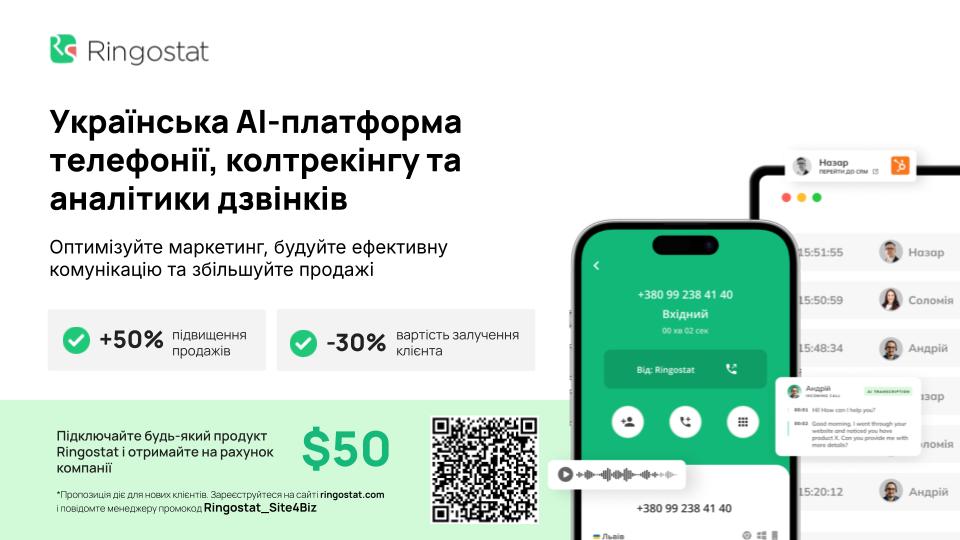
$50 for new Ringostat customers from Site 4 biz
If you decide to try out Ringostat for your business, a partner promo code is available for Site 4 biz customers and readers:
Ringostat_Site4Biz
He credits $50 to the company’s account when Ringostat is activated.
To take advantage of this offer:
- Sign up on the Ringostat website via the Site 4 biz affiliate linkto receive a $50 bonus credited to your company’s account.
- When speaking with a Ringostat manager, mention the promo code Ringostat_Site4Biz. Once you’re set up, you’ll receive a $50 bonus credited to your company’s account.
The promo code is available to new customers, cannot be combined with other special offers, and is valid through December 31, 2026.
If phone calls play a significant role in your sales, testing such a system can be useful even beyond the phone calls themselves. It can reveal something much more interesting— what actually happens to a customer after marketing has brought them to your business.