A unified digital platform for securing road construction contracts and selling related materials
We created a Ukrainian-language website for a company that builds roads, highways, access roads, and other types of road surfaces.
During the project planning phase, it was anticipated that the company would continue to develop a separate line of business focused on the sale of materials used in road construction and urban improvement.
So, we first launched a website within 7 days to showcase the company and its services, and over the next week, we expanded it to include online store functionality.
The company did not receive two separate resources, but rather a single digital platform through which it can:
- provide road construction services;
- showcase our experience and completed projects;
- receive requests for calculations;
- publish a catalog of building materials;
- accept orders for products;
- promote services and products through individual pages.
Language of the first version: Ukrainian
Phase 1: Company website in 7 days
Phase 2: Expansion to an online store over the next 7 days
Platform: WordPress + WooCommerce + Elementor
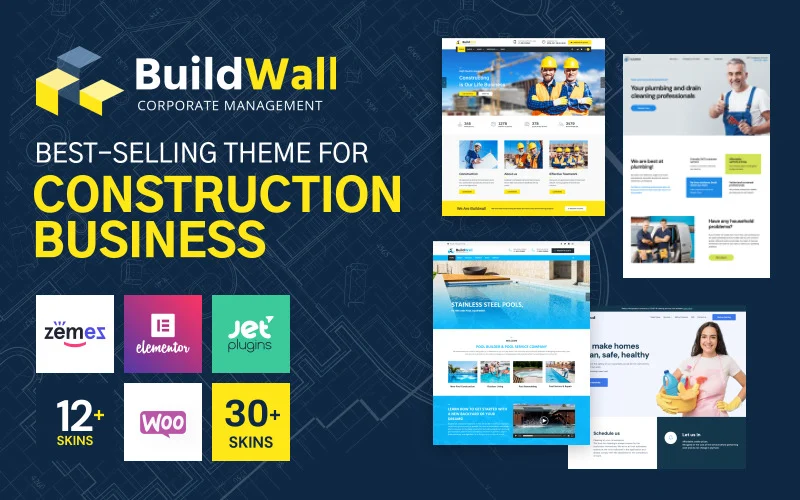
Design template: premium design from Template Monster: BuildWall – Construction Company Multipurpose WordPress Theme.
View Demo
Task
The company needed a website that would help:
- to professionally present the road construction sector;
- list the types of work;
- explain what types of properties the company works with;
- demonstrate your skills and experience;
- receive requests from private, corporate, and government clients;
- work properly on smartphones;
- lay the groundwork for SEO promotion;
- add the sale of materials in the future;
- Do not create a separate website for the online store;
- gradually expand the business without a complete platform relaunch.
A key requirement was the ability to develop the project in phases.
In the first phase of the business, a service website was needed. In the second phase, a full-fledged product line was required, complete with a catalog, product listings, and the ability to place orders.
Our Approach
The project utilized a professional design framework developed for construction, engineering, industrial, and road-building companies.
It already included logic for:
- company profile;
- individual service pages;
- portfolio;
- news;
- commands;
- partners;
- contacts;
- product catalog;
- product cards;
- online store.
This made it possible to build the website in advance so that adding the online store would not require:
- platform changes;
- creating a second website;
- content migration;
- a complete redesign;
- navigation restructuring;
- relaunch of the entire project.
A premium template was used as the technical and visual foundation, and the site’s structure was adapted to fit the specific business model.
A phased rollout instead of a lengthy development process
The company could have ordered a complex website with every possible feature right away and waited several months for it to be completed.
Instead, they opted for a phased approach.
Phase One
We launched the company’s website to showcase:
- areas of work;
- road construction services;
- advantages;
- contact information;
- opportunities to provide feedback on the project.
Stage Two
We expanded the website into an online store with the following features:
- create product categories;
- add products;
- display prices and specifications;
- use the shopping cart;
- accept online orders.
This approach allowed the business to launch a functional website more quickly and then add a new line of business without having to start the project from scratch.
Why Does a Road Construction Company Need Its Own Website?
Contracts for road and infrastructure projects often involve substantial budgets and require a preliminary review of the contractor.
A potential customer wants to understand:
- what services the company provides;
- what types of objects it works with;
- what techniques and materials he uses;
- Is there any experience with similar projects?;
- in which regions it operates;
- whether it can perform a range of tasks;
- how a cost estimate is prepared;
- whether they are employed under a contract;
- whether it has the necessary permits and documents;
- how to contact the person in charge.
The website helps bring all this information together in one place and supports sales regardless of where a potential customer comes from:
- from Google;
- based on a recommendation;
- from the tender platform;
- from advertising;
- from the catalog;
- from email;
- from social media;
- after a face-to-face meeting;
- after receiving a commercial proposal.
Two business lines on one website
A distinctive feature of the project is the combination of two related areas.
Construction Services
A company may represent:
- road construction;
- road resurfacing;
- paving;
- construction of access roads;
- construction of sites;
- landscaping;
- preparation of the base;
- installation of curbs;
- paving;
- other specialized work.
Sale of Materials
Through the online store, you can offer:
- paving stones;
- curbs;
- road components;
- bulk materials;
- landscaping materials;
- construction mixtures;
- related products;
- materials that the company uses in its own projects.
These areas reinforce one another.
A customer looking for materials can find out about installation services. A client commissioning construction work can purchase the necessary products from the same supplier.
The website should sell not only the artwork, but also a curated sales experience
A road construction client doesn’t just buy:
- asphalt;
- paving stones;
- laying;
- the operation of the equipment.
He needs results:
- prepared site;
- a properly constructed foundation;
- durable coating;
- meeting deadlines;
- a clear cost estimate;
- supply of materials;
- coordination of work;
- quality control;
- documentation;
- readiness of the facility for use.
Therefore, it makes sense to structure service pages according to the following logic:
- Which facility needs to be equipped?
- What problems need to be solved.
- What kind of work does the company do?
- What materials can be used?
- How the preparation and implementation take place.
- What determines the cost?
- What result does the client receive?
- How to Request a Preliminary Estimate.
Structure of Service Pages
You shouldn’t list all the categories in a single, general list.
You can create individual pages under:
- road construction;
- paving;
- road repairs;
- pothole repair;
- construction of access roads;
- construction of parking lots;
- construction of industrial sites;
- paving;
- installation of curbs;
- preparation of the road subgrade;
- landscaping;
- removal of the old flooring;
- road construction for businesses;
- construction projects for residential complexes;
- projects for municipal utilities.
Each page can correspond to a specific search query and be used in advertising.
A structure tailored to different types of customers
A road construction company may work with several target audiences.
Individual Customers
They may need:
- access roads;
- courtyards;
- parking spaces;
- paths;
- paving;
- landscaping.
Business
Companies can order:
- construction of roads leading to the site;
- parking;
- the area near the warehouse;
- industrial site;
- the pavement near the shopping center;
- production area;
- internal roads;
- Repair of the existing pavement.
Developers and General Contractors
The following are important to them:
- dates;
- documentation;
- coordination;
- technical compliance;
- supply of materials;
- the ability to complete a specific step;
- Work experience on large-scale projects.
Government and municipal clients
The following may be important for this segment:
- official information about the company;
- documents;
- experience;
- technical capabilities;
- completed projects;
- participation in procurement;
- compliance with requirements;
- Contact information for the person in charge.
As the project develops, a separate page can be created for each segment.
SEO Basics for Construction Services
Potential customers may be searching for:
- road construction;
- a road construction company;
- paving;
- asphalt repair;
- paving;
- construction of a parking lot;
- construction of an access road;
- landscaping;
- paving of an industrial site;
- roadwork in a specific city;
- a road construction contractor.
Therefore, the website can be developed gradually through:
- individual service pages;
- pages for different types of objects;
- pages tailored to different types of customers;
- local pages;
- portfolio;
- cases;
- equipment pages;
- information about technologies;
- answers to frequently asked questions;
- industry articles;
- external publications;
- trade catalogs.
This allows you to attract customers not only based on the company name, but also based on the specific type of work.
SEO Fundamentals for an Online Store
A product category creates an additional group of search results pages.
Shoppers can search for:
- buy paving stones;
- road curbs;
- building materials;
- landscaping materials;
- paving stones from a manufacturer or supplier;
- the price of a specific material;
- delivery of construction materials;
- materials in a specific region;
- a specific type or model of product.
To that end, you can develop the following on the website:
- categories;
- subcategories;
- product cards;
- brand pages;
- pages of content;
- filters;
- local pages;
- directions for use;
- instructions;
- comparison;
- related products;
- internal linking.
In this way, a single domain can build visibility for both services and products.
The Relationship Between Services and Goods
A particular advantage of this type of website is the ability to link product and service pages.
For example:
- On the paving stones page, you can offer installation services;
- on the curbs page—installation;
- On the asphalting page—materials for site preparation;
- in the product listing—guidance on calculating the quantity;
- in the case study of the completed project—links to the materials used;
- In the article on choosing flooring—related products and services.
This helps:
- increase the average value per visit;
- receive comprehensive orders;
- demonstrate practical expertise;
- improve internal linking;
- guide the client through various business areas.
What the client received
As part of the completed project, the client received:
- the company’s Ukrainian-language website;
- mobile optimization;
- a professional construction design framework;
- the WordPress content management system;
- a framework for providing services;
- the ability to add new pages;
- a framework for the company’s presentation;
- online store features;
- the WooCommerce system;
- product categories;
- product cards;
- shopping cart;
- placing an order;
- the ability to add products on your own;
- the ability to change prices, photos, and descriptions;
- a platform for future SEO and advertising;
- a website that can be further developed or handed over to another team.
Portfolio of Road Construction Projects
For a company that carries out infrastructure projects, its portfolio can be one of the main ways to demonstrate its experience.
Each item can be treated as a separate case:
- object type;
- region;
- area or length;
- initial state;
- task;
- scope of work;
- materials used;
- equipment used;
- dates;
- result;
- Photos taken before, during, and after the work.
If possible, you can add:
- the customer;
- review;
- technical specifications;
- volume of materials;
- complexity;
- video;
- documents;
- links to the products used.
Case studies like these help potential customers see real-life experiences rather than abstract promises.
Trust Blocks
Before entering into a contract, the customer evaluates:
- experience;
- command;
- equipment;
- scope of work;
- completed projects;
- documents;
- partners;
- materials;
- warranties;
- dates;
- responsibility;
- financial and organizational capacity.
You can post the following on the website:
- years of experience;
- number of objects;
- regions;
- fleet of equipment;
- command;
- partners;
- certificates;
- licenses and permits, if required;
- documents;
- reviews;
- photos of the sites;
- sample cost estimate;
- Stages of quality control.
It is important to use only factual and verified data.
Product Card
A building material card can display the following:
- title;
- photos;
- price;
- availability;
- unit of sale;
- manufacturer;
- material;
- size;
- weight;
- color;
- technical specifications;
- scope of application;
- cost per unit of area;
- storage conditions;
- warranty;
- certificates;
- shipment dates;
- shipping terms;
- related products;
- installation service.
For some products, the traditional ordering process may be inconvenient due to:
- large volumes;
- the relationship between price and quantity;
- weight;
- complex logistics;
- the need for a calculation;
- Supply region.
In this case, you can continue to develop the store by clicking the button:
- Request a quote;
- Check the price;
- Schedule a consultation;
- Calculate shipping costs;
- Get a quote.
Preliminary Estimate for Construction Work
You can add a form to the website where the customer can specify:
- object type;
- settlement;
- area;
- the length of the road;
- width;
- current status;
- the type of coating required;
- the need to prepare the base;
- preferred dates;
- contact information;
- photos;
- a plan or technical specifications.
The form should not promise a final price without an on-site visit and assessment of the property.
Her task is to gather basic information and prepare for a substantive discussion.
Stages of Collaboration
For the construction sector, we can outline a clear process.
1. Receipt of a Request
The client describes the object and the desired result.
2. Preliminary Consultation
The scope, deadlines, location, and initial conditions are being finalized.
3. Field Visit and Inspection
A specialist assesses the site, the condition of the foundation, access, and technical constraints.
4. Preparing the Decision
The technology, materials, stages, and necessary equipment are determined.
5. Estimate and Contract
The quantities, deadlines, payment terms, and responsibilities of the parties are specified.
6. Supply of Materials
If necessary, the company supplies the facility with products from its product line.
7. Performance of Work
The team is implementing the agreed-upon plan.
8. Monitoring and Submission
The quality is checked, and the completion of the work is documented.
An Online Store as a Support for the Core Business
A product line can serve several functions.
An additional source of revenue
The company sells materials to customers who do not need a full range of services.
Equipping Our Own Facilities
The website can feature materials used in projects.
Reaching a New Audience
A customer may come in through a product inquiry and then order installation or construction services.
Working with Partners
The following individuals may purchase the materials:
- construction companies;
- repair crews;
- landscape contractors;
- developers;
- public utilities;
- stores;
- wholesale customers.
Building Trust
The company’s own catalog shows that it not only understands materials in theory but also applies that knowledge in its day-to-day operations.
B2B and B2G segments
The website can be developed to support:
- developers;
- general contractors;
- manufacturing companies;
- logistics complexes;
- shopping centers;
- residential complexes;
- agricultural enterprises;
- public utilities;
- local communities;
- government contracting authorities.
A separate section may include:
- experience;
- technical capabilities;
- fleet of equipment;
- documents;
- completed projects;
- geography;
- terms of cooperation;
- request for a commercial proposal;
- Contact information for the tender or project manager.
For the B2G audience, the website can also help maintain the company’s reputation during the vetting of a procurement participant.
Technical Documentation
The following factors may be important for products and construction solutions:
- certificates;
- declarations;
- passports;
- technical specifications;
- instructions;
- specifications;
- diagrams;
- Terms of Use;
- warranty documents;
- catalogs;
- price lists.
Documents may be posted:
- in product listings;
- on the pages of the materials;
- in the Partners section;
- in the document database;
- in the client’s office.
This helps reduce the number of follow-up requests to managers and makes the work of designers and procurement specialists easier.
Payment and Delivery of Materials
The online store can be integrated with the following:
- online payment;
- by bank transfer;
- by issuing an invoice;
- payment upon approval;
- pickup;
- via our own delivery service;
- transportation companies;
- calculating logistics costs;
- order status updates.
When it comes to heavy construction materials, it is especially important to explain:
- minimum order;
- unit of sale;
- weight;
- loading conditions;
- delivery area;
- unloading capability;
- dates;
- the relationship between price and volume;
- the need for prior approval.
Integration with CRM and Accounting Systems
As the site develops, it can be integrated with:
- CRM;
- ERP;
- warehouse management software;
- accounting system;
- telephony;
- via corporate email;
- electronic document management;
- project management system;
- analytics.
Synchronization is possible:
- goods;
- prices;
- remnants;
- orders;
- customers;
- project inquiries;
- statuses;
- documents;
- accounts.
The specific integration depends on the software the company uses and the available technical capabilities.
Content for two areas
The website can attract traffic through useful content on:
- selection of road surface;
- preparation of the base;
- asphalt and pavers;
- road repairs;
- coating maintenance;
- causes of destruction;
- construction of parking lots;
- construction of access roads;
- selection of materials;
- calculating the quantity;
- laying technique;
- seasonality of work;
- completed projects;
- Comparison of solutions.
Content can guide the reader:
- before ordering the work;
- to the product category;
- for a specific material;
- for a consultation;
- In response to a request for a cost estimate.
A single piece of content can simultaneously support SEO, social media, email, advertising, and the work of managers.
The Role of Advertising
You can run various advertising campaigns for the website.
For services
- paving;
- road construction;
- repair of the pavement;
- paving;
- construction of parking lots;
- landscaping.
On products
- paving stones;
- curbs;
- road construction materials;
- landscaping materials;
- specific product categories.
For a B2B audience
- comprehensive landscaping of the area;
- supply of materials;
- contract work;
- commercial sites;
- industrial facilities.
It’s better to run ads not only on the home page, but also on individual pages for services, categories, or industry-specific solutions.
How to Further Develop the Website
The next steps could be:
- specific pages related to road services;
- pages for different types of objects;
- web pages for B2B and B2G;
- local pages;
- detailed case studies;
- portfolio;
- equipment page;
- Documents page;
- expanding the catalog;
- product filters;
- search;
- materials calculator;
- request for a quote;
- request for a commercial proposal;
- wholesale prices;
- personal account;
- balances synchronization;
- integration with CRM;
- integration with ERP;
- online payment;
- shipping estimate;
- product feeds;
- Google Merchant Center;
- remarketing;
- SEO;
- Google Ads;
- Meta Ads;
- multilingualism;
- international shipments;
- technical documentation database.
The specific direction of growth depends on the ratio of services to product sales in the company’s business model.
How the customer saves money in the future
The main cost savings of this project stem not only from the use of a professional design framework.
The website was designed from the outset with the future store in mind.
As a result, the customer saves:
- time required for the initial startup;
- the budget for creating a second website;
- redesign costs;
- funds for content migration;
- It’s time to reconfigure the mobile version;
- costs associated with a separate inventory management system;
- a budget for promoting two different domains;
- time spent creating new pages;
- funds for a complete overhaul as part of the catalog expansion;
- the costs associated with a closed platform that is difficult to transfer to another team.
A single website can evolve alongside the company’s services, product lineup, geographic reach, and new business areas.
Why We Chose a Premium Design
A construction company’s website and online store have many standard elements:
- the main clause;
- service pages;
- portfolio;
- command;
- partners;
- news;
- contact forms;
- catalog;
- categories;
- product cards;
- shopping cart;
- placing an order;
- mobile version.
Building each element from scratch would increase the timeline and the budget.
This professional foundation made it possible to:
- launch a service website in one week;
- add an online store in another week;
- Do not change the platform;
- Do not create a separate resource;
- maintain a consistent brand structure;
- Move more quickly to customer acquisition and sales.
In this case study, the premium template served its primary purpose—it allowed the business to develop its website in phases without having to completely overhaul it.
Order Promotion strategy for a construction website with a store
Are you looking for a website that can be expanded into an online store in the future?
Site 4 biz Build creates digital platforms for:
- road construction companies;
- contractors;
- suppliers of building materials;
- pavers;
- landscaping companies;
- engineering companies;
- distributors;
- B2B suppliers;
- companies that combine services with the sale of goods.
We can help:
- launch the company’s website;
- to plan the future store in advance;
- create service pages;
- create a portfolio;
- add a directory;
- Set up WooCommerce;
- organize the sale of materials;
- submit a request for a commercial proposal;
- set up payment and shipping;
- synchronize prices and inventory levels;
- set up analytics;
- improve SEO;
- launch an ad;
- Combine services, products, content, and sales on a single website.
Write about your projectgoals, available resources, and we will help you achieve them.