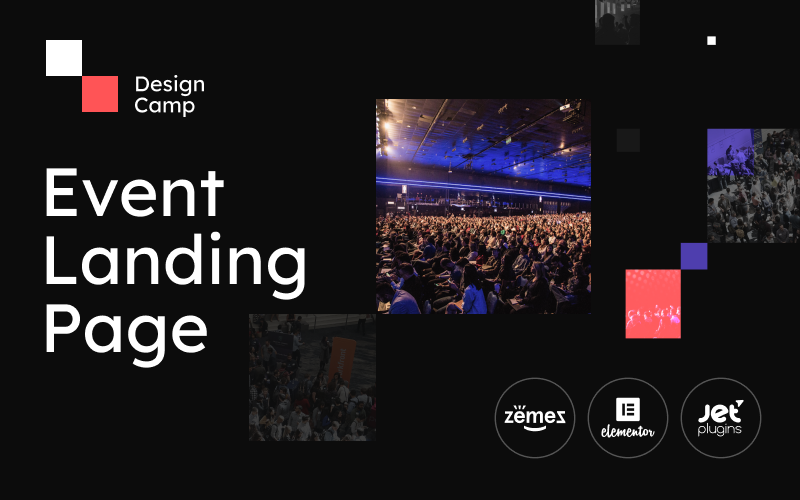
A landing page to showcase the program and attract participants
We created a Ukrainian-language landing page for a specific event in the events, leisure, and entertainment sector.
This page helps you quickly explain the concept of the event, present the program, participants, date, and venue, and convert visitor interest into registration or another desired action.
The project is optimized for mobile devices and can be used to promote:
- conferences;
- festival;
- exhibitions;
- Congress;
- forum;
- workshop;
- business event;
- cultural event;
- entertainment event;
- presentations;
- thematic meeting.
Language of the first version: Ukrainian
Launch time: 2 days
Platform: WordPress + Elementor
Design template: premium design from Template Monster DesignCamp – Modern Event Landing Page Platform WordPress Theme.
View Demo
Task
The event required a compact landing page that would help:
- present the concept for the event;
- explain who it is intended for;
- show the date and location;
- install the program;
- to introduce the organizers or participants;
- answer the main questions;
- simplify the registration process;
- work properly on smartphones;
- use the page in an advertisement;
- quickly launch a campaign to promote the event.
The main goal was not to create a large corporate website, but to quickly launch a standalone page for a specific event.
Our Approach
For this project, we used a premium design template created specifically for events, conferences, and presentations.
It allows you to map out a visitor’s journey:
- View the title and main theme of the event.
- Understand who it’s for.
- View the program.
- Meet the speakers, participants, or performers.
- Find out the visiting hours.
- Get answers to your questions.
- Sign up or proceed to purchase a ticket.
The template was used as a technical and visual framework that can be adapted to the style, format, and target audience of a specific event.
Why Does a Specific Event Need a Landing Page?
You can share information about the event on social media, messaging apps, via email, and in advertisements.
But without a dedicated page, important data often remains scattered:
- The date is included in one post;
- a different program;
- information about participants in Stories;
- the address in the message;
- payment terms in private correspondence;
- Changes are published as separate updates.
The landing page brings together all the latest information in one place.
You can bring people there from:
- Google;
- Facebook;
- Instagram;
- LinkedIn;
- TikTok;
- YouTube;
- email newsletters;
- Telegram;
- partner websites;
- posters;
- QR codes;
- outdoor advertising;
- speaker and participant profiles.
A landing page should sell an experience, not a ticket
A potential participant considers more than just the entry price.
He wants to understand:
- what will happen;
- Why You Should Come;
- whoever he meets;
- what he learns or feels;
- how he will spend his time;
- what result he will get;
- whether the event aligns with his interests;
- whether it will be easy to get there;
- included in the price;
- Can the organizers be trusted?
Therefore, it makes sense to structure the page not around a formal description, but around the expected value for the user.
Recommended Landing Page Structure
First Screen
The first screen should immediately display:
- event name;
- a brief summary;
- date;
- city or format;
- main effect.
Example of a structure:
Event Name
A brief explanation of who it’s for and why you should join.
Date, location, format.
Conversion element.
Who is this event for?
A separate section helps visitors quickly determine whether an event matches their interests.
For example:
- entrepreneurs;
- experts;
- specialists in a particular field;
- families with children;
- creative people;
- business representatives;
- to investors;
- students;
- professional communities;
- to fans of a particular topic.
The more precisely the target audience is described, the easier it is for a person to decide whether to participate.
What Participants Will Receive
Depending on the format of the event, these may include:
- new knowledge;
- practical tools;
- dating;
- professional contacts;
- consultations;
- access to experts;
- presentations;
- entertainment;
- presentations;
- workshops;
- new experiences;
- the opportunity to showcase your own product;
- participation in a professional community.
It’s important to describe specific benefits, not just general advantages.
Event Program
The program is one of the main components of the landing page.
It can be organized as follows:
- by time;
- by day;
- behind the scenes;
- through the halls;
- by topic;
- by activity type.
For each item, you can display:
- time;
- title;
- brief description;
- a speaker or participant;
- location;
- format;
- duration.
If the program is still being finalized, the page can be updated as new participants are confirmed.
Speakers, artists, or participants
It is important for the conference to introduce the speakers.
For the festival—artists, hosts, artisans, or partners.
The following can be displayed in the profile:
- a photograph;
- name;
- position or role;
- company;
- specialization;
- the topic of the presentation;
- a brief biography;
- link to the profile;
- Duration of participation in the program.
Real participants are often one of the main reasons for signing up.
Venue
The page should clearly show:
- location name;
- address;
- map;
- mode of transportation;
- parking conditions;
- accessibility of public transportation;
- login features;
- registration start time;
- accessibility for visitors with limited mobility;
- Arrival guidelines.
If the event is held online, you need to explain:
- on which platform;
- how the participant will receive the link;
- Will there be a recording?;
- What are the technical requirements?;
- when the reminder is sent.
Tickets and Participation Options
An event may offer several ways to participate:
- free registration;
- standard ticket;
- one-day ticket;
- a ticket valid for all days;
- VIP participation;
- family ticket;
- corporate package;
- online participation;
- a ticket that includes additional activities;
- exhibitor kit;
- Affiliate package.
For each option, it is important to show:
- cost;
- included;
- restrictions;
- the price’s validity period;
- return policy;
- number of available seats;
- the next step.
In the first stage, the landing page may lead to a registration form or an external ticketing platform.
Registration
The registration form may collect:
- name;
- phone;
- email;
- company;
- position;
- the selected participation format;
- number of participants;
- promo code;
- consent to data processing.
For certain formats, you can add:
- company details;
- the need for an account;
- selecting a workshop;
- partnership request;
- application to perform;
- exhibitor application.
The form should be short enough so as not to create unnecessary obstacles to registration.
Trust Blocks
Before registering, visitors can evaluate:
- who is organizing the event;
- Did the organizer hold any other events?;
- who has already confirmed their participation;
- which partners are sponsoring the event;
- Are there any photos from previous events?;
- Are there any reviews?;
- Are the payment terms clear?;
- Can I get a refund for my ticket?;
- Where to get support.
The page can include:
- information about the organizers;
- partner logos;
- participant profiles;
- reviews;
- photos;
- video;
- statistics on previous events;
- media mentions;
- answers to questions;
- Team Contacts.
It is important to use only factual information and verified partners.
Photos and Videos
When it comes to events, it’s especially important to convey the atmosphere.
On the landing page, you can display:
- photos from previous events;
- a short promotional video;
- a video message from the organizer;
- introduction of the speakers;
- location;
- excerpts from speeches;
- participant feedback;
- preparations for the event.
If the event is being held for the first time, you can use:
- visual concept;
- real photos of the location;
- a video message from the team;
- speakers’ materials;
- Program announcements.
You shouldn’t give the impression that photos from other events are part of this particular project.
Partners and Sponsors
A landing page can be useful not only for visitors but also for partners.
A separate block can display:
- general partner;
- media partners;
- technical partners;
- sponsors;
- exhibitors in the exhibition area;
- partner organizations;
- media.
You can also add a page or form for companies that want to:
- Become a partner;
- set up a booth;
- to speak;
- supply products;
- support the event;
- Get a presentation on the partnership packages.
Frequently Asked Questions
On this page, it’s helpful to answer:
- where the event will take place;
- when registration begins;
- what’s included in the ticket;
- Can I buy a ticket at the venue?;
- Can I get a refund for my ticket?;
- Will there be a recording?;
- Can I transfer my ticket to someone else?;
- Are any documents required?;
- Can I bring my children?;
- Is there a closet?;
- whether food is available;
- Is there parking?;
- How to contact the organizer.
This module reduces the workload on the support team.
Landing Page for Advertising
A landing page can be used for:
- Google Ads;
- Meta Ads;
- LinkedIn Ads;
- advertising on TikTok;
- partner newsletters;
- email;
- advertising in niche media;
- promotion through speakers;
- advertising on Telegram;
- offline materials with a QR code.
You can create separate advertising messages for different audiences.
For example:
- for visitors;
- for businesses;
- for partners;
- for speakers;
- for exhibition participants;
- for families;
- for the professional community.
As the business grows, you can create additional landing pages for specific segments.
Event Analytics
On the landing page, you can track:
- number of visitors;
- sources of transitions;
- pressing buttons;
- Start filling out the form;
- completed registrations;
- Proceed to checkout;
- tickets purchased;
- redeemed promo codes;
- the effectiveness of affiliate links;
- registration fee;
- the conversion rates of various advertising campaigns.
To do this, you can connect:
- web analytics;
- advertising pixels;
- tag manager;
- CRM;
- email system;
- ticketing platform;
- a system for tracking promo codes.
The specific composition of the packages depends on the method of registration and ticket sales.
Emails and Messages to Participants
Once you’ve registered, you can set up communication:
- proof of participation;
- ticket;
- reminder;
- program update;
- login instructions;
- map;
- information about the speakers;
- notification of changes;
- post-event materials;
- request for feedback;
- a suggestion for the next event.
This helps reduce the number of missed visits and stay in touch with the audience.
After the event is over
You don’t have to take the landing page down immediately after the event ends.
It can be updated and used for:
- photos;
- video;
- speakers’ materials;
- presentations;
- results;
- reviews;
- mentions in the media;
- Acknowledgments to our partners;
- pre-registration for the next event.
This allows you to retain your accumulated traffic, links, and trust.
If the event recurs, the page can be expanded into a full-fledged website with:
- an archive of past events;
- individual pages of the years;
- a permanent roster of speakers;
- news;
- sponsored content;
- early registration.
SEO Fundamentals for Landing Pages
A landing page can be optimized for the main search queries related to a specific event:
- event title;
- a conference on a specific topic;
- a festival in a specific city;
- exhibition;
- Congress;
- forum;
- events on a specific date;
- a professional event for a specific audience.
To do this, you need to provide for the following:
- clear H1;
- date;
- city;
- topics;
- program;
- participants;
- text description;
- answers to questions;
- metadata;
- optimized images;
- structured information about the event.
A single landing page has limited potential for large-scale SEO.
For recurring events, the website can be further expanded through:
- speaker profiles;
- thematic feed pages;
- news;
- interview;
- archive;
- coverage of previous events;
- partner pages;
- informational articles.
What the client received
- Ukrainian-language landing page;
- mobile optimization;
- a professional design framework for events;
- the WordPress content management system;
- the ability to edit text and photos;
- a framework for presenting the event;
- the ability to host the program;
- blocks for displaying participants;
- a section for ticket information;
- contact blocks;
- the basis for the registration form;
- readiness to launch the ad campaign;
- the foundation for basic SEO optimization;
- the ability to integrate analytics;
- a platform that can be scaled to meet the needs of the event.
How to Further Develop a Landing Page
The next steps could be:
- registration form;
- online payment;
- integration with the ticketing system;
- automatic tickets;
- QR codes;
- various types of participation;
- promo codes;
- speaker profiles;
- detailed program;
- personal account;
- integration with CRM;
- email automation;
- reminder;
- Partners page;
- partnership application;
- speaker application;
- exhibitor application;
- live stream;
- restricted access to materials;
- multilingualism;
- SEO;
- advertisement;
- remarketing;
- archive of past events;
- the website of a recurring festival or conference.
How the customer saves money in the future
Using a professional design template saved us time and money that would otherwise have been spent creating standard event blocks from scratch.
The customer saves:
- startup time;
- budget for the basic design;
- costs associated with mobile adaptation;
- time required to deploy the application;
- funds to create separate pages for each information block;
- time for routine updates;
- ad testing budget;
- costs associated with a closed platform;
- funds to rebuild the website for the next event.
If necessary, the landing page can be updated for the next event or expanded into a full-fledged website for an ongoing project.
Why We Chose a Premium Design
Event landing pages have the following standard elements:
- first screen;
- date and location;
- advantages;
- program;
- speakers;
- partners;
- tickets;
- answers to questions;
- registration form;
- map;
- contact blocks;
- mobile version.
Building each element from scratch would extend the timeline and increase the budget, but it wouldn’t necessarily help us start the promotion any sooner.
Thanks to our professional foundation, we were able to move on to the main points in just two days:
- event presentations;
- launching an ad;
- recruiting participants;
- collection of registrations;
- further updates to the program.
Order Landing page promotion strategy
Need a landing page for an event?
Site 4 biz Build creates landing pages for:
- conferences;
- forums;
- conventions;
- festivals;
- exhibitions;
- workshops;
- business events;
- cultural events;
- professional meetings;
- online events;
- presentations;
- entertainment events.
We can help:
- launch a landing page quickly;
- establish a structure;
- present the program;
- register speakers or participants;
- add tickets and participation options;
- connect the registration form;
- integrate a payment system or an external ticketing system;
- set up analytics;
- prepare the page for advertising;
- set up email communication;
- Expand the landing page into a full-fledged website for a recurring event.
Tell us about your project: available resources, goals—and we’ll help you achieve them.