A landing page for presenting projects and soliciting applications
We created a Ukrainian-language landing page for a professional or company that provides landscape design and landscaping services.
This page helps showcase our approach to work, present our main services, highlight examples of completed projects, and convert a potential client’s interest into a request for a consultation, a site visit, or a preliminary project discussion.
The landing page is optimized for mobile devices and can be used as a quick template for advertising, presenting a specific service, or as the first step in developing a full-fledged website.
Language of the first version: Ukrainian
Launch time: 2 days
Platform: WordPress + Elementor
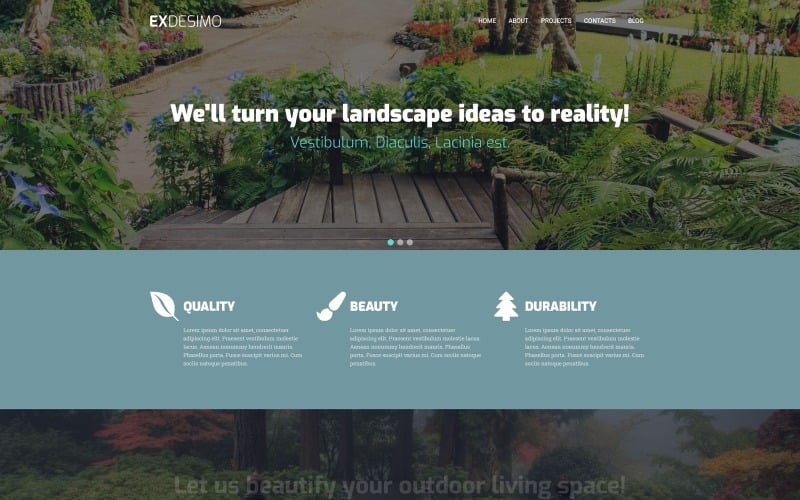
Design template: premium design from Template Monster —Exdesimo – Landscape Multipurpose Modern WordPress Elementor Theme.
View Demo
Task
For the landscape design service, we needed a compact landing page that would help:
- to professionally represent a specialist or a company;
- explain what services can be ordered;
- demonstrate the visual aspects of future solutions;
- show examples of projects;
- build trust;
- explain the stages of cooperation;
- make the initial contact easier;
- work properly on smartphones;
- use the page in advertising campaigns;
- quickly assess the demand for a service.
It was important not to drag out the launch for several months, but rather to establish a professional foundation that could be gradually expanded with real photos, case studies, reviews, and new service areas.
Our Approach
For the launch, we used a premium design framework created for landscape, architectural, and design projects.
Its strength lies in large photos and visual blocks that allow you to showcase:
- the site prior to the start of work;
- concept;
- landscaping details;
- plant combinations;
- paths;
- lighting;
- decorative elements;
- the final result.
The template was used not as ready-made content, but as a foundation for creating a clear customer journey:
- See the result.
- Understand what services are provided.
- Evaluate the approach.
- View examples.
- Find out how it works.
- Submit a request.
This made it possible to quickly launch the first version of the page while leaving room for future development.
Why a Landing Page Is Suitable for Landscape Design
A landing page works well when you need to promote:
- one core service;
- a specific seasonal offer;
- a service in a specific region;
- a separate format for the work;
- the company’s new direction;
- ads targeted at a specific audience.
For example, you can create a separate page at:
- landscaping of the lot;
- comprehensive improvement;
- landscaping;
- garden design;
- automatic watering;
- grounds maintenance;
- landscaping of a commercial property;
- landscaping of terraces;
- renovation of the existing garden.
This format helps avoid overwhelming visitors with too many options and guides them toward a single, clear call to action.
A landing page should sell not plants, but the future space
A client commissioning a landscape design isn’t just buying:
- lawn;
- trees;
- bushes;
- flower beds;
- paths;
- lighting.
He wants to get:
- a well-planned area;
- a comfortable space to relax;
- a harmonious blend of the house and the lot;
- clear zoning;
- plants that are suited to the conditions of the site;
- a controlled budget;
- the projected appearance of the area;
- fewer errors during implementation;
- a system that can be maintained after the work is completed.
Therefore, it makes sense to structure the page not just around a list of services, but around the results the client will receive.
Recommended Landing Page Structure
First Screen
The first screen should display:
- what services the company offers;
- for which objects;
- in which region;
- what result the client receives;
- How to take the first step.
Example wording:
Landscape Design for Properties—From Concept to Completed Space
We design well-thought-out layouts and select plants, materials, and solutions for both private and commercial spaces.
Conversion element.
The client’s problem
This page can highlight the situations that are most frequently reported:
- It’s unclear where to start with the improvements;
- The site has a complex topography;
- The plants never take root;
- the various elements of the area do not blend together;
- The work is being carried out without a joint plan;
- the budget is spent on processing;
- the space is impractical for everyday use;
- The old garden needs to be renovated;
- The site for the new house must be prepared.
This section helps visitors identify their own situation.
Decision
Next, it is worth explaining that landscape design helps determine in advance:
- zoning;
- functional areas;
- routes;
- plant placement;
- lighting;
- watering;
- drainage;
- small architectural features;
- materials;
- sequence of tasks;
- estimated budget.
The client receives not a set of random solutions, but a comprehensive concept for the site.
Services
The landing page can highlight the main areas of focus:
- consultation;
- trip to the site;
- measurements;
- analysis of the territory;
- concept;
- zoning;
- master plan;
- dendroplan;
- plant selection;
- lighting plan;
- automatic irrigation schedule;
- visualization;
- sales support;
- design supervision;
- Comprehensive urban improvement.
You don’t have to include all the services.
It’s best to show only the ones that the team actually provides.
A structure tailored to different types of clients
This service may be needed for various types of facilities:
- private property;
- a country house;
- townhouse;
- a cottage community;
- residential complex;
- restaurant;
- hotel;
- office;
- retail space;
- a medical or health facility;
- areas near the production facility;
- public space.
Each type of object has different tasks.
For a private client, the following are important:
- comfort;
- privacy;
- ease of care;
- a place for children;
- recreation area;
- seasonality.
The following may be important for businesses:
- appearance;
- first impression;
- plant resistance;
- navigation;
- maintenance;
- brand alignment;
- Readiness of the site for the facility’s opening.
As they grow, specific audiences can be moved to their own landing pages.
Visual Presentation
Landscape design is a visual service.
Therefore, the following elements are particularly important on the page:
- real photos;
- visualizations;
- diagrams;
- master plans;
- before-and-after photos;
- parts of plants;
- the seasonal appearance of the area;
- short videos;
- the sales process.
Large photographs should not only set the mood but also bring the experience to life.
If there aren’t many completed projects yet, you can showcase:
- concepts;
- visualizations;
- educational projects;
- excerpts from plans;
- the decision-making process.
At the same time, it is important to clearly distinguish between what is an implementation and what is a concept.
Portfolio
Each project can be presented using a clear structure:
- object type;
- area;
- region;
- initial state;
- the client’s requirements;
- characteristics of the area;
- the proposed concept;
- solutions used;
- scope of work;
- term;
- result.
You can even feature 3–5 short case studies on the landing page.
In the future, each of these can be moved to a separate page for a more detailed description and SEO optimization.
Stages of Collaboration
It is important for the client to understand not only the result but also the process.
1. Application
The client describes the lot, its area, location, and the desired outcome.
2. Initial Discussion
The objectives, budget, timeline, and format of the collaboration are being finalized.
3. Site Visit and Analysis
The specialist evaluates:
- topography;
- lighting;
- soil;
- existing plants;
- buildings;
- communications;
- Land use characteristics.
4. Concept
The overall concept, layout, and style are being developed.
5. Design
The necessary plans, diagrams, and visualizations are being prepared.
6. Approval
The client receives the materials, asks questions, and approves the decisions.
7. Implementation
The work may be performed by the designer’s team, the client’s contractors, or jointly engaged specialists.
8. Support
If necessary, the author provides supervision, consultation, and revisions.
This section reduces uncertainty and helps prepare the client for the initial contact.
What the customer receives
Depending on the agreed-upon format, the result may be:
- concept;
- zoning plan;
- master plan;
- dendroplan;
- seating chart;
- lighting plan;
- irrigation schedule;
- list of plants;
- materials specification;
- visualization;
- care instructions;
- implementation plan;
- supervision of the work.
On the landing page, it’s important to clearly specify what is included in a particular service.
First Contact Form
For an initial application, you may ask:
- name;
- phone or messaging app;
- settlement;
- the area of the lot;
- object type;
- current status;
- the service you need;
- preferred dates;
- estimated budget;
- A brief description of the task.
You can also add the option to attach:
- photos;
- site plan;
- surveying;
- examples of styles you like.
The form shouldn’t be too complicated.
Her goal is to gather enough information for a substantive initial conversation.
Trust Blocks
Before contacting us, a customer can assess:
- real-world projects;
- experience;
- specialization;
- education;
- approach;
- reviews;
- process;
- price transparency;
- willingness to work under a contract;
- meeting deadlines;
- partners;
- suppliers;
- the ability to provide support throughout the implementation process.
The page can include:
- a photo of the specialist or team;
- a brief professional history;
- certificates;
- examples of drawings;
- reviews;
- cases;
- scope of work;
- answers to frequently asked questions;
- photos of the process.
When it comes to building trust, authentic materials are more important than a large number of decorative elements.
What Factors Determine the Cost?
On the landing page, you can explain that the price depends on:
- areas;
- the condition of the territory;
- topography;
- the composition of the documentation;
- the number of zones;
- visualization needs;
- the necessity of the trip;
- the nature of engineering solutions;
- implementation support;
- deadlines;
- region.
You don’t have to publish the full price list.
However, it is helpful for the client to understand:
- What type of work is being offered;
- included;
- At which stage can you start?;
- which is calculated separately.
SEO Fundamentals for Landing Pages
A landing page can be optimized for a single main cluster of search queries, for example:
- landscape design;
- landscape designer;
- site design;
- garden design;
- landscape design in a specific city;
- landscaping project.
To do this, it is important to include the following on the page:
- clear H1;
- service description;
- region of operation;
- sections on the process;
- examples of projects;
- answers to frequently asked questions;
- text descriptions;
- optimized images;
- metadata;
- internal links.
At the same time, a single landing page has limited potential for large-scale SEO.
To improve search visibility, the website can be further expanded through individual pages:
- landscape design of a private lot;
- landscaping;
- landscaping;
- automatic watering;
- garden design;
- grounds maintenance;
- Landscape design for businesses;
- services in specific cities;
- cases;
- Helpful articles.
In other words, a landing page can serve as the first step rather than the final limit to a website’s development.
Landing Page for Advertising
A landing page is a great way to get started:
- Google Ads;
- ads on Facebook and Instagram;
- an advertising campaign targeting a specific region;
- promoting a seasonal service;
- testing the new offer;
- advertising consultations;
- Advertisements for on-site visits.
For better conversion rates, ads should match the page’s content.
For example, it’s best to direct ads for private lot design to a page that shows:
- private properties;
- design phases;
- examples;
- composition of the result;
- application form.
You shouldn’t direct all your advertising campaigns to a single, one-size-fits-all page if your services and target audiences differ significantly.
Google Maps and Local Presence
If a professional or company operates in a specific city, the landing page can be linked to a Google Business Profile.
A profile can show:
- address;
- service area;
- phone;
- hours of operation;
- photos;
- reviews;
- link to the website;
- examples of work;
- News.
The website and the Google profile must contain consistent information.
The following can be particularly useful for local marketing:
- reviews;
- photos of actual projects;
- names of regions;
- pages for cities;
- mentions on local resources;
- Current contact information.
The Role of Social Media
Instagram, Facebook, Pinterest, YouTube, and TikTok can support landing pages through:
- before-and-after photos;
- the design process;
- plant selection;
- seasonal changes;
- Quick Tips;
- site inspections;
- video of the implementation;
- answers to questions;
- Meet the designer;
- Go to the application page.
Social media helps showcase work on a regular basis, while a landing page presents a structured offer and guides visitors toward taking action.
Site 4 biz Growth can combine landing pages, Google Maps, SEO, social media, content, advertising, and analytics into a single system for generating leads.
How the page can be further developed
The next steps could be:
- individual service pages;
- pages for different types of objects;
- local pages;
- a comprehensive portfolio;
- detailed case studies;
- blog;
- a designer’s or team’s page;
- reviews;
- preliminary cost calculator;
- form for uploading a site plan;
- schedule a consultation;
- meeting schedule;
- CRM;
- email;
- messaging apps;
- Google Business Profile;
- local SEO;
- Google Ads;
- Meta Ads;
- remarketing;
- video content;
- multilingualism;
- pages for business customers;
- Partner pages for architects and developers.
The specific direction of development depends on the area of specialization, the region, the range of services, and the number of projects completed.
What the client received
- Ukrainian-language landing page;
- mobile optimization;
- a photo-oriented design framework;
- the WordPress content management system;
- the ability to edit text and photos;
- a template for presenting a single service;
- sections for sample work;
- the ability to outline the stages of collaboration;
- contact blocks;
- a template for the application form;
- the ability to insert a card;
- readiness to launch the ad campaign;
- the foundation for basic SEO optimization;
- the ability to integrate analytics;
- a platform that can later be expanded into a full-fledged website.
How the customer saves money in the future
Using a professional design template saved us time and money that would otherwise have been spent creating standard landing page blocks from scratch.
The customer saves:
- time required for the initial startup;
- budget for the basic design;
- costs associated with mobile adaptation;
- time to test the new service;
- funds for full processing when adding content;
- costs for a separate closed platform;
- the time it takes to find a developer for routine changes;
- a budget for future expansion of the website.
If demand is confirmed, the landing page can be gradually transformed into a multi-page website without having to start from scratch.
Why We Chose a Premium Design
Landscape design landing pages typically include the following elements:
- a strong opening screen;
- large photos;
- list of services;
- portfolio;
- stages of cooperation;
- reviews;
- application form;
- map;
- contact blocks;
- Mobile version.
Building all of these elements from scratch would increase the timeline and budget, but it wouldn’t necessarily help us get our first leads any faster.
This professional foundation allowed us to quickly get to the point:
- formulation of the proposal;
- presentations of works;
- launching an ad;
- demand assessments;
- receipt of applications;
- further development.
Order A strategy for promoting a landing page for landscape design
Need a landing page for landscaping services?
Site 4 biz Build creates landing pages and websites for:
- landscape designers;
- landscaping companies;
- landscapers;
- garden centers;
- automatic irrigation companies;
- exterior designers;
- architects;
- contractors;
- breeding facilities;
- landscaping services.
We can help:
- launch a landing page quickly;
- to offer a separate service;
- create the page structure;
- create a portfolio;
- add an application form;
- enable analytics;
- prepare the page for advertising;
- Set up a Google Business Profile;
- develop local SEO;
- turn the landing page into a full-fledged website;
- Integrate the website, maps, social media, advertising, and content into a customer acquisition system.
Write about your projectgoals, available resources, and we will help you achieve them.